n8n has become one of the most popular tools for automating business processes — especially for teams that want to self-host, write a little code when they need to, and connect AI models to their workflows. That popularity also means a lot of people now list "n8n" on their profile. This guide helps you tell the difference between someone who has followed a few tutorials and someone who can build automations your business can rely on.
Start with what you actually need
Before you look at a single profile, write down the job in one or two sentences. For example:
- "Route inbound leads from our forms to HubSpot, enrich them, and alert sales in Slack."
- "Build an AI agent that answers support emails using our help-center articles, and hands off to a human when unsure."
- "Move our 40 Zapier zaps to a self-hosted n8n instance."
These are three very different jobs. The first is classic integration work. The second needs someone comfortable with LLMs, retrieval and guardrails. The third needs migration and infrastructure experience. Knowing which one you have makes every next step easier.
Look at real workflows, not keyword lists
The most useful signal is proof of work: workflows they have built, ideally with a short explanation of the problem and the result. Good things to see:
- Exported workflows or screenshots with sensible node names — not "HTTP Request 7".
- A Loom or video walkthrough where they explain why they built it that way.
- Results in plain language: "cut onboarding from two days to ten minutes", "handles 500 leads a week".
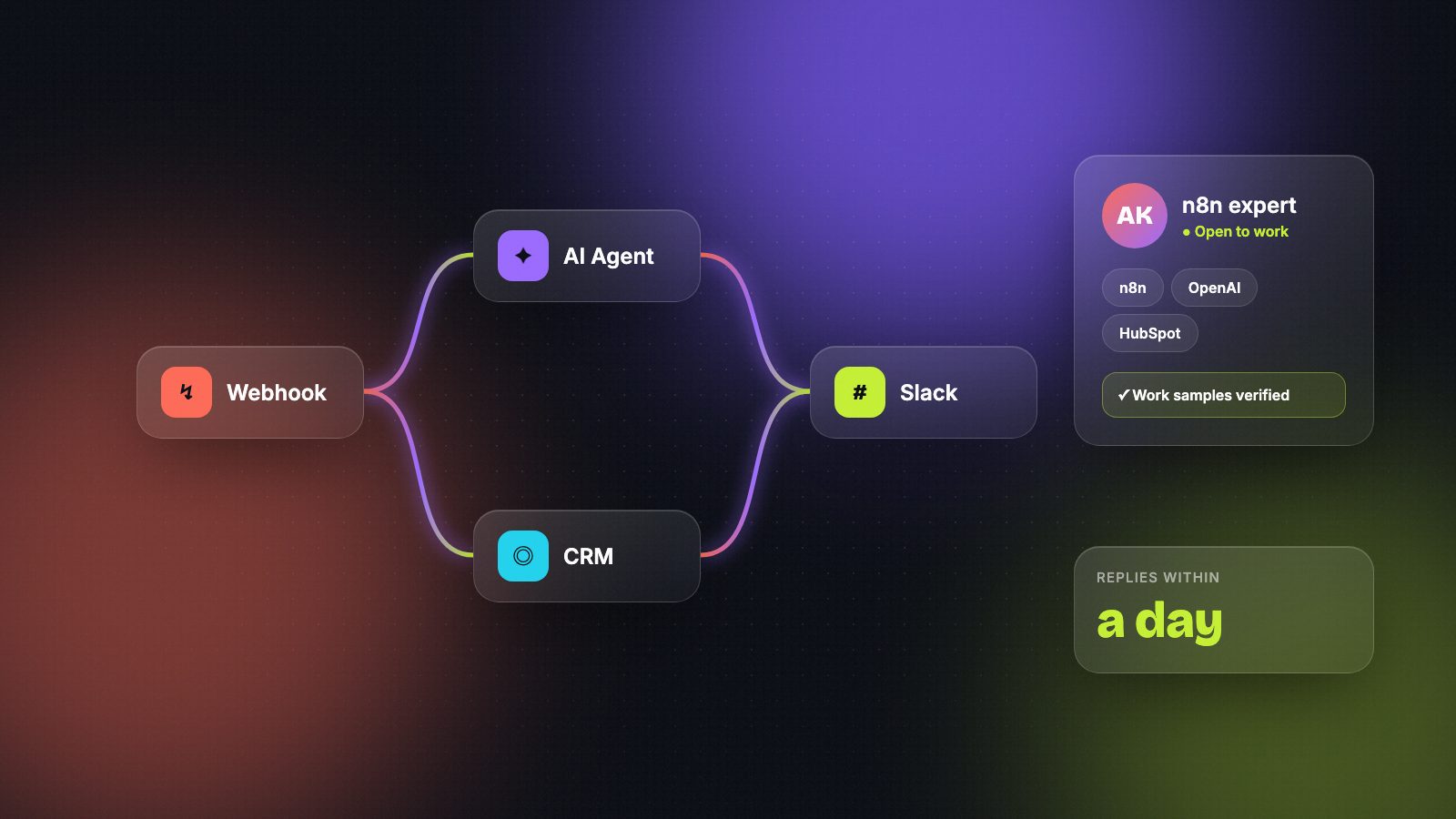
On our platform every builder adds work samples to their profile, and verified profiles show that we have reviewed them. You can browse n8n experts here.
Check the parts that break in production
Anyone can build a workflow that works once. Ask about the things that matter after launch:
- Error handling. What happens when an API is down or returns something unexpected? Do they use error workflows, retries and alerts?
- Credentials and security. How do they store API keys? Have they worked with least-privilege access?
- Self-hosting (if you need it). Have they run n8n with a database, queues and backups — not just the desktop app?
- Code nodes. Can they write a small JavaScript or Python step when a visual node isn't enough?
- Documentation. Will someone else on your team understand the workflow in six months?
Questions worth asking in the first call
- "Walk me through a workflow you're proud of. What broke after it went live, and how did you fix it?"
- "How would you approach our problem? What would you build first?"
- "How do you handle rate limits and retries?"
- "Have you connected n8n to an LLM? How did you keep the output reliable?"
- "What do you need from us to get started?"
Good builders answer with specifics and ask you questions back. Vague answers about "automating everything with AI" are a warning sign.
Red flags
- No examples they can show or describe in detail.
- They promise a fixed result before understanding your systems.
- Every answer involves an AI agent, even when a simple workflow would do.
- They can't explain how they would monitor the automation once it's running.
Freelance, contract or full-time?
For a single project — a migration, a few core workflows — a freelancer or contractor is usually the fastest route. If automation is becoming central to how your company runs, consider a longer contract or a full-time hire who can own it. Profiles on our platform show whether a builder wants freelance work, a full-time role, or either.
The short version
Define the job, look for real workflows, ask about failure handling, and talk to people who are actually available. That last point matters more than most hiring guides admit: the best profile in the world is no use if the person never replies.
Frequently asked questions
What does an n8n expert do?
They design, build and maintain workflows in n8n: connecting your apps and APIs, handling webhooks, transforming data, adding AI agent steps, and making it all reliable with error handling and alerts. Many can also set up and run a self-hosted n8n instance for you.
Is n8n hard to learn?
The basics are approachable for anyone comfortable with technology. Production work is harder: it often needs some JavaScript, an understanding of APIs and JSON, and — if you self-host — server and security knowledge. That gap is where an expert saves time.
Should I self-host n8n or use n8n Cloud?
n8n Cloud means no server to maintain. Self-hosting gives you full control of your data and setup, but you become responsible for updates, backups and security. A good n8n expert can set up either and explain the trade-offs for your case.
How do I test an n8n expert before hiring?
Ask them to walk you through an exported workflow or a short screen recording of something they built, then start with a small, paid task that has a clear result. How they handle errors and documentation tells you more than any CV.
Hire AI automation builders who actually reply.
Verified builders with real workflows on every profile — free during launch.